That Netflix is still debated continues to be one of the funniest things to me. It’s the Costco of entertainment with an arguably even simpler flywheel.
It is the clear global streaming leader and, similarly to Costco, it is one of the last things you would ever cancel, probably even in a recession.
For comparison, the average U.S. movie ticket is now roughly $13.50 for a single movie versus Netflix at $9 a month with ads.
And even among streaming services, Netflix seems to be the last one most of us would cancel. Its monthly churn has hovered around just 2%, versus 4.6% for major premium streamers overall.
And this is where the extremely powerful flywheel at the heart of Netflix sits. Netflix has by far the largest subscriber base. This means Netflix can spread its largely fixed global content costs across 325M+ memberships.
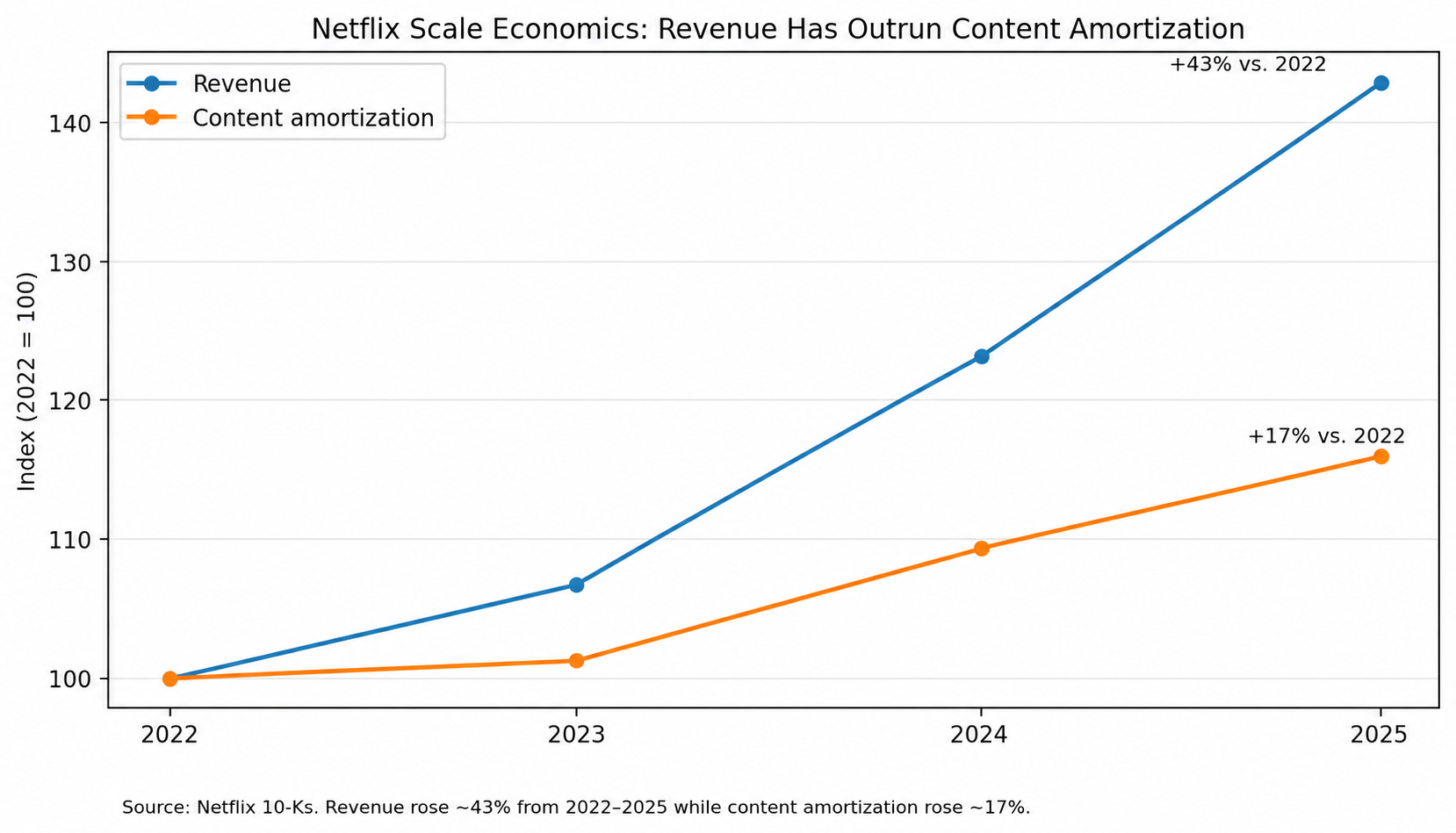
Netflix revenue grew roughly 43% from 2022 to 2025 while content amortization grew roughly 17%. Source: Netflix annual reports.
This, in turn, allows it to fund a broader and more diverse slate of movies and shows. That lets it appeal to more viewers and provide a more valuable proposition to each of them. This keeps Netflix’s churn significantly below competitors. Lower churn then makes reinvestment more predictable, completing the flywheel.
Netflix is a stunning example of a scale-economics flywheel. Almost sounds a bit like a massive warehouse with high membership density?
And the operating leverage is now showing up dramatically in the financials: Netflix’s operating margin has risen from 17.8% in 2022 to 29.5% in 2025, with 31.5% targeted for 2026.
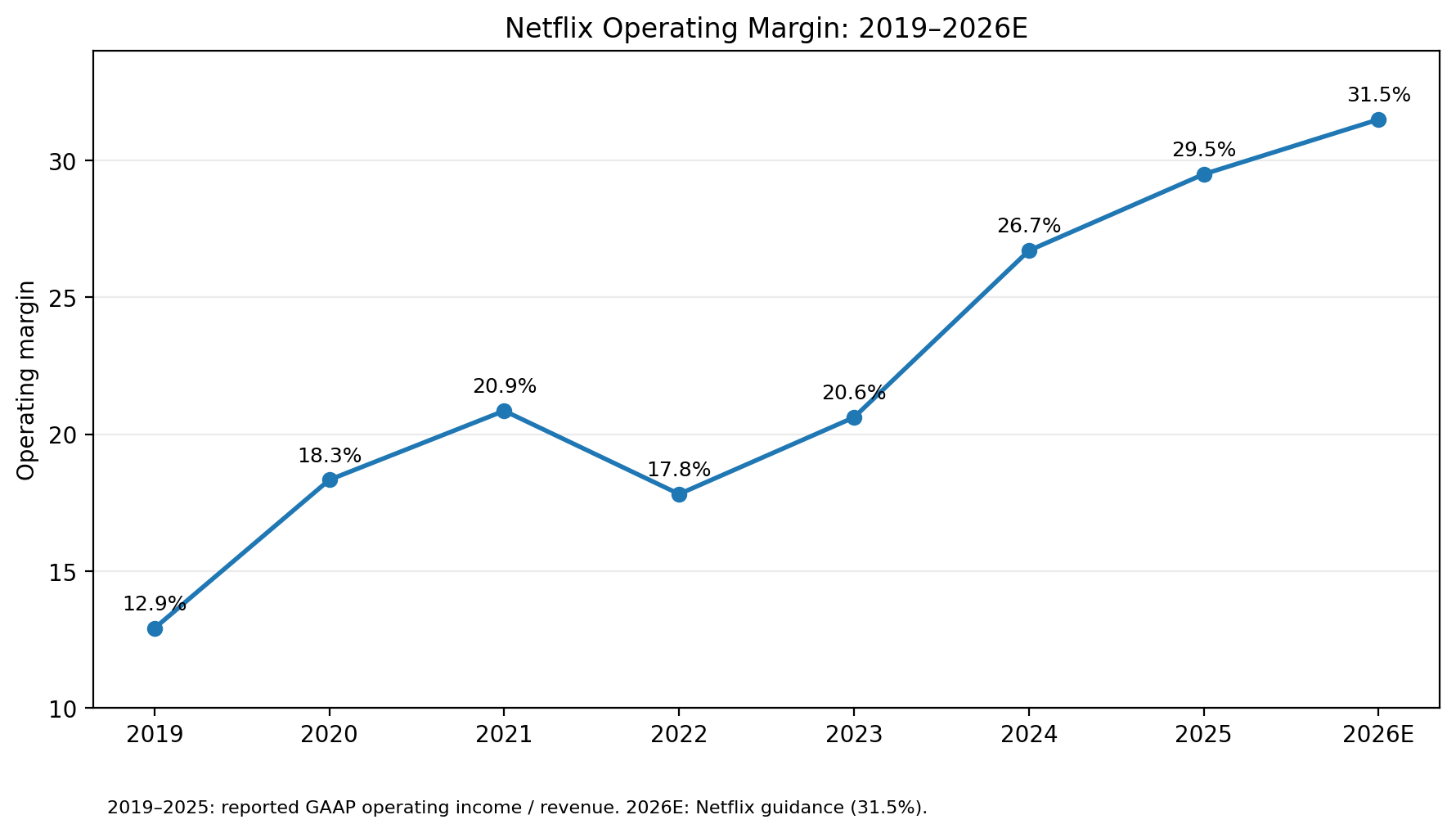
2019–2025 are reported GAAP operating margins; 2026 is Netflix guidance.
This advantage is also partially structural. Netflix was built from scratch around one global streaming model, while Disney must optimize across streaming, linear TV, theatrical, sports, and other legacy economics.
I understand that Netflix is in an attention competition with Meta, TikTok, YouTube, and others. I think that is the strongest bear case. And as a matter of fact, I think some attention will naturally continue shifting that way.
That being said, long-form premium storytelling is a fundamentally different format, and one that will not go away. It’s something we as humans simply enjoy.
Netflix does not need to win all of our attention. It only needs to remain valuable enough that effectively unlimited premium long-form entertainment for $9 with ads or $20 without ads remains an easy subscription to keep.